The 7 Best Shovels of 2026
These are the shovels we would pick for yard, garden and job-site work, each matched to the job it does best. We weighed blade shape and steel, the blade-to-handle joint, handle material and length, and weight, using maker specs and listing data.
Our top picks at a glance


The shape of the blade decides the job. A round point concentrates your weight to pierce firm, dry or rocky soil, so it is the digging shovel. A square point has a flat nose that slides under a pile, so it moves, spreads and levels sand, gravel, mulch and topsoil. A scoop has a much wider blade for lifting light, loose material in volume, such as grain, snow and wood chips. Root-cutting designs like the Root Slayer add a sharpened tip and serrated edges so you can saw through roots without switching tools.
The Root Slayer leads because it handles hard ground and roots, the two things that stop most shovels. After that, each pick is a strong choice for its type. We favored reinforced sockets and necks, since the blade-to-handle joint is where shovels usually fail, along with clear published specs. Scores are research-based.
#1 Best Overall
Radius Garden Root Slayer Shovel
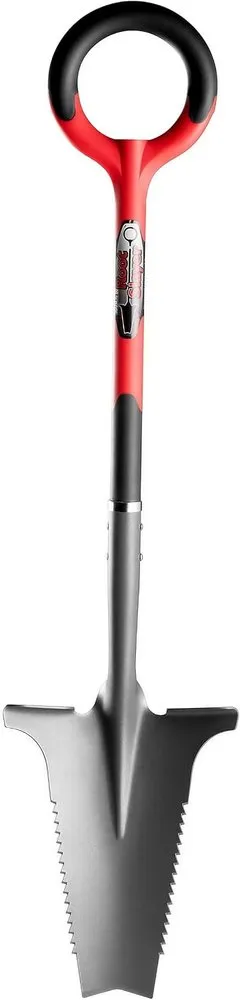
The Root Slayer is our top pick because it handles the ground that stops ordinary shovels. A sharpened inverted-V tip focuses force to pierce hard-packed soil and clay, and serrated rip-saw edges cut through roots as you dig, so it works as a shovel, root saw and root hatchet in one. The 13-gauge carbon steel blade is powder coated against rust, and a resin-encased steel shaft ends in an O-handle for a relaxed grip. The main limit: Radius says it isn't meant for prying, so leave rocks and stumps to a digging bar.
Pros
- Inverted-V tip pierces hard-packed soil and clay
- Serrated edges saw through roots without switching tools
- Powder-coated 13-gauge carbon steel blade resists rust
- O-handle keeps your hands in a relaxed, natural grip
Cons
- Not intended for prying or heavy leverage, per the maker
- At about 5 to 5.5 pounds, heavier than a basic garden spade
- Sharp serrations call for gloves and care when cleaning
| Type | Serrated digging shovel, inverted-V tip |
|---|---|
| Blade | 13-gauge carbon steel, powder coated, 13 x 10.5 in |
| Handle | Resin-encased carbon steel shaft, O-handle |
| Overall length | About 44 in (31 in handle) |
| Weight | About 5 to 5.5 lb |
→ Check today's price on the Radius Garden Root Slayer Shovel
#2 Best Square Point
Razor-Back Square Point Shovel with Tab Socket
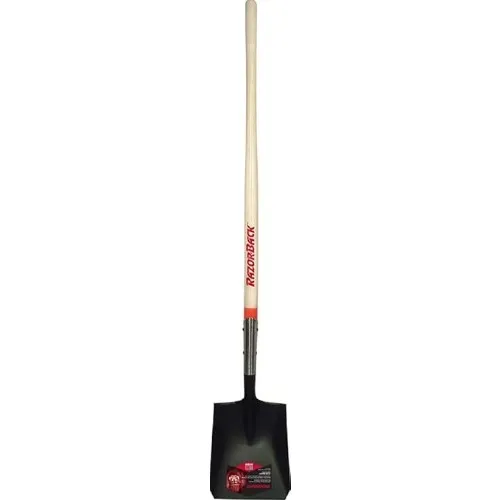
For moving loose material, this is the square point to get. The flat nose of its open-back, industrial-gauge steel blade slides under sand, topsoil, debris or concrete mix and lifts a full, even load, and it doubles as a scraper and leveling tool. A dual-rivet extended tab socket reinforces the joint where shovels usually break, and a rolled step helps prevent material build-up while giving your boot a platform. The 48-inch hardwood handle gives good leverage, but it wants dry storage, and a square nose won't bite into hard ground.
Pros
- Flat square nose scoops loose material cleanly and scrapes hard surfaces
- Dual-rivet extended tab socket strengthens the handle joint
- Rolled step limits material build-up and gives your boot a platform
- 48-inch hardwood handle for leverage and a more upright stance
Cons
- A square nose won't bite into hard or rocky soil like a round point
- The wood handle needs dry storage and an occasional oiling
- The open back can collect wet, sticky soil behind the blade
| Type | Square point, open back, rolled step |
|---|---|
| Blade | Industrial-gauge alloy steel |
| Handle | 48-inch North American hardwood, dual-rivet tab socket |
| Overall length | About 58.25 in |
| Weight | 4.9 lb |
→ Check today's price on the Razor-Back Square Point Shovel with Tab Socket
#3 Best Scoop
Razor-Back Steel Scoop with Wood Handle and D-Grip
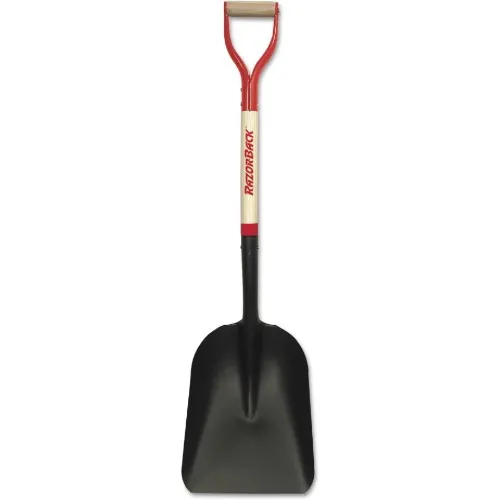
When the job is lifting loose material in volume, a scoop beats any shovel, and this one is built for it. The Eastern-pattern carbon steel blade measures 11 by 15 inches, far bigger than a digging blade, and steel stands up to gravel and ice better than a plastic scoop. A 27-inch ash handle with a wood and steel D-grip gives two-handed control for tipping loads into bins, wheelbarrows and truck beds. The maker lists grain, snow, mulch and general cleanup. It won't dig, and the short handle means more bending if you're tall.
Pros
- Wide 11 x 15-inch blade moves a lot of material per load
- Steel blade handles gravel, ice and scraping better than plastic
- D-grip with a steel yoke gives firm two-handed control
- Short handle is easy to maneuver in sheds, barns and truck beds
Cons
- Not a digging tool: the wide, flat blade won't cut firm soil
- The short handle means more bending if you're tall
- A full blade of wet snow or damp mulch gets heavy fast
| Type | Eastern-pattern steel scoop |
|---|---|
| Blade | Carbon steel, 11 x 15 in (W x L) |
| Handle | 27-inch ash, wood and steel D-grip |
| Overall length | About 41.5 in |
| Weight | 5.3 lb |
→ Check today's price on the Razor-Back Steel Scoop with Wood Handle and D-Grip
#4 Best Round Point
Razor-Back Open Back Shovel with Wood Handle
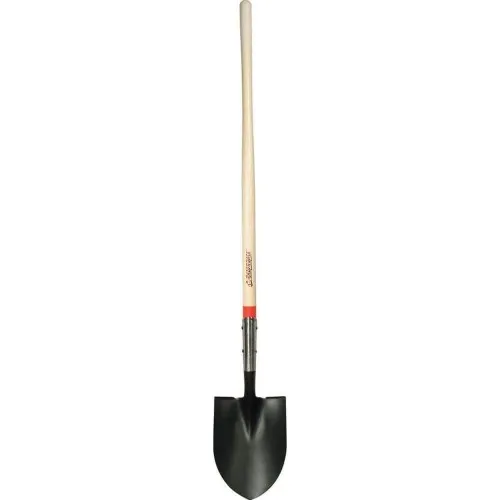
This is a classic contractor's round point for digging holes, trenches and planting pits in mixed ground. The pointed nose concentrates your weight to slice into compacted, dry or stony soil, and the industrial-gauge blade is tempered so it resists chipping and bending when you pry against a root or rock. An extended tab socket is designed to reduce handle breakage, and a forward-turned step gives your boot a solid platform. The 48-inch Northern White Ash handle keeps the feel traditional. Listing details vary on back style and handle, so check before you order.
Pros
- Round point pierces hard, dry and rocky soil more easily than a flat blade
- Tempered industrial-gauge steel blade built for excavation
- Extended tab socket is designed to reduce handle breakage
- Northern White Ash handle is strong, with a little shock-absorbing flex
Cons
- Slower than a square point for scooping loose piles
- The wood handle needs dry storage and occasional oiling
- Listing details vary on back style and handle material, so check the photos
| Type | Round point, open back, forward-turned step |
|---|---|
| Blade | Tempered industrial-gauge alloy steel |
| Handle | 48-inch Northern White Ash, extended tab socket |
| Overall length | About 58.25 in |
| Weight | About 4.3 lb |
→ Check today's price on the Razor-Back Open Back Shovel with Wood Handle
#5 Best D-Grip Square Point
Bully Tools 14-Gauge Square Point Shovel
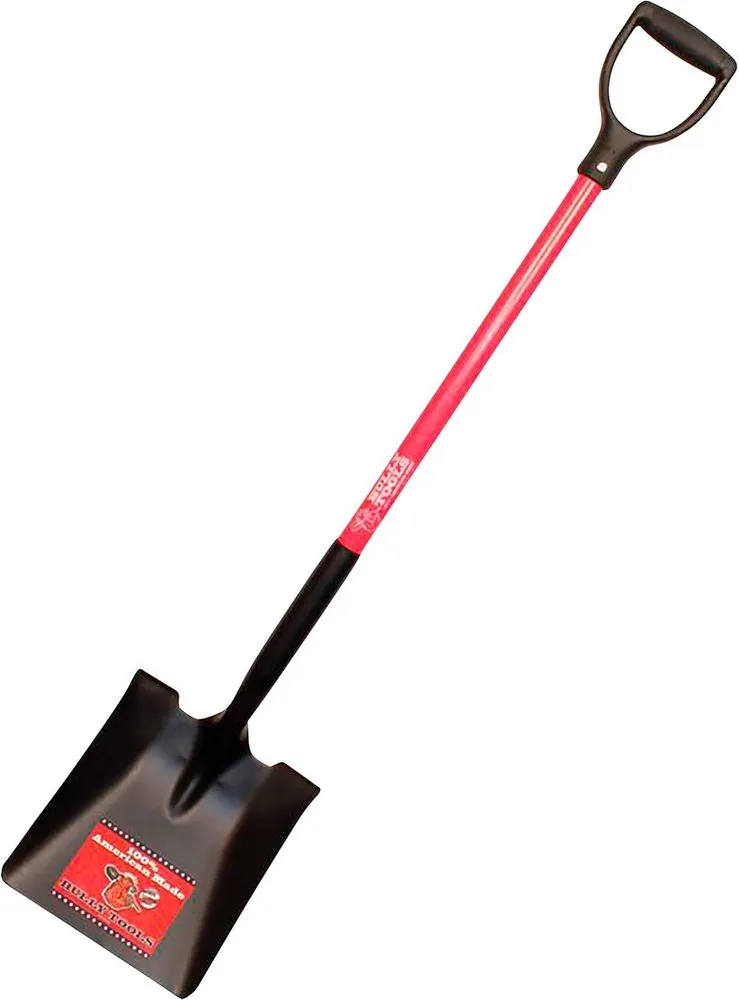
The Bully Tools square point is the compact, fiberglass-handled alternative to the Razor-Back. Its 14-gauge USA steel head, 11 by 9.5 inches, carries a full scoop of gravel, mulch, soil or snow, and the flat edge levels and spreads cleanly. An extended steel-encased neck with rivets resists flex, the veil-coated fiberglass handle won't splinter or rot, and the 46-inch D-grip gives close control when loading a wheelbarrow. It is made in Steubenville, Ohio. The handle has no internal dowel, so it is built for scooping rather than heavy prying.
Pros
- 14-gauge USA steel head, powder coated against rust
- Extended steel-encased neck with rivets resists flex
- Veil-coated fiberglass handle won't splinter, swell or rot
- Glove-friendly D-grip gives close control when loading
Cons
- No internal dowel in the handle, so avoid heavy prying
- A 46-inch D-grip means more bending on big piles
- Needs a quick assembly with two Phillips screwdrivers
| Type | Square point |
|---|---|
| Blade | 14-gauge USA steel, powder coated, 11 x 9.5 x 1.5 in |
| Handle | Fiberglass, polypropylene D-grip, no internal dowel |
| Overall length | 46 in |
| Weight | 4.8 lb |
→ Check today's price on the Bully Tools 14-Gauge Square Point Shovel
#6 Best for Tall Diggers
Razor-Back Long Super Socket Round Point Shovel
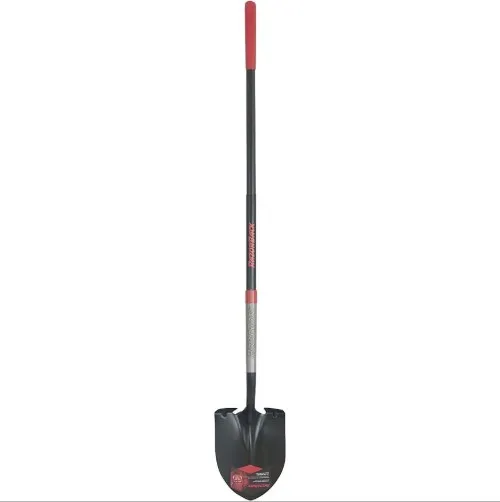
At about 62 inches overall, this round point gives taller diggers extra reach and the leverage to pop a loaded blade out of heavy ground. Razor-Back's SuperSocket reinforces the joint where blade meets handle, the spot that takes the most stress when you pry. The alloy steel blade has the general-purpose round point shape, and the metal handle won't rot or splinter if it lives outside. It ranks lower because its published specs are thin, with no blade gauge, step type or handle length, and at 5.2 pounds it is on the heavy side.
Pros
- About 62 inches overall for extra reach and leverage
- SuperSocket reinforces the stress point where blade meets handle
- Metal handle won't rot or splinter if it's left outside
- Round point alloy steel blade suits general digging
Cons
- Published specs are thin: no blade gauge, step type or handle length
- At about 5.2 pounds, it's on the heavy side for a round point
- The extra length can feel unwieldy in tight beds and trenches
| Type | Round point, long |
|---|---|
| Blade | Alloy steel |
| Handle | Metal, ergonomic grip, SuperSocket |
| Overall length | About 62.25 in |
| Weight | 5.2 lb |
→ Check today's price on the Razor-Back Long Super Socket Round Point Shovel
#7 Best D-Grip Round Point
Bully Tools 14-Gauge Round Point Shovel
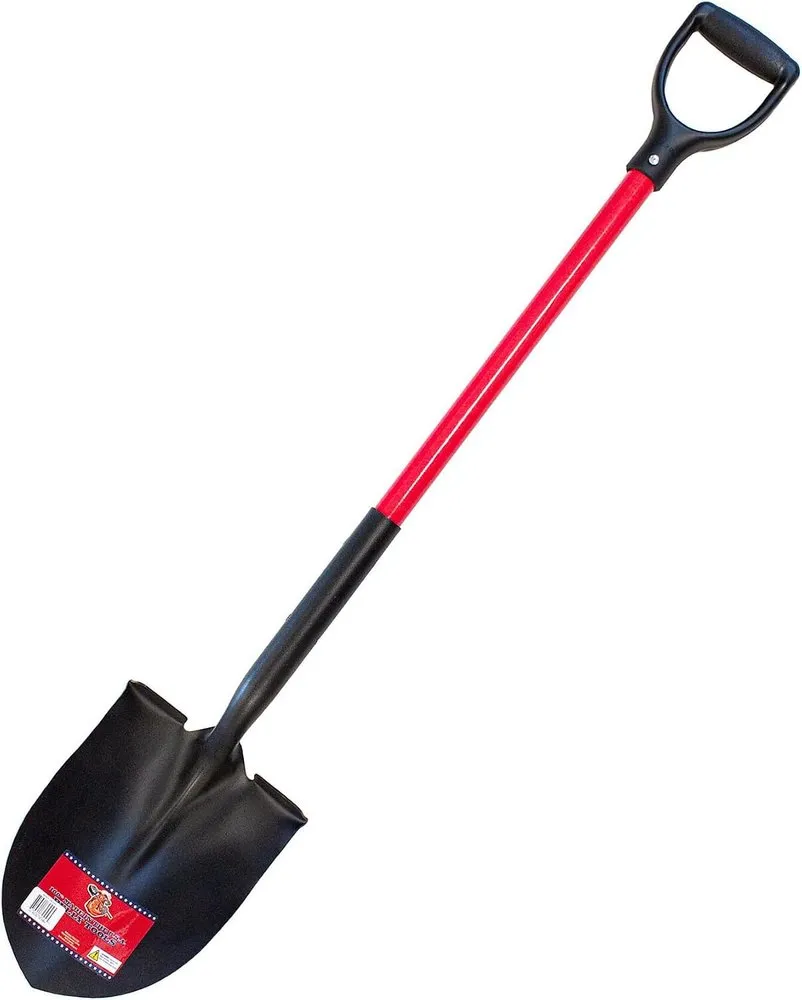
The Bully Tools round point is a heavy-gauge digging shovel sized for control rather than reach. Its 14-gauge USA steel blade is powder coated against rust, an extended riveted neck reinforces the joint where blade meets handle, and a wide foot plate lets you step down and dig deeper. At 46 inches with a D-grip, it suits planting holes, garden beds, edging around pavers and trenching. The veil-coated fiberglass handle resists moisture and won't splinter. If you are tall and want maximum leverage, a long-handled round point is the better fit.
Pros
- Thick 14-gauge USA steel blade, powder coated against rust
- Extended riveted neck reinforces the blade-to-handle joint
- Wide foot plate lets you step down and dig deeper
- Fiberglass handle resists moisture and won't splinter
Cons
- 46 inches overall is short for tall diggers wanting leverage
- The open back can hold sticky, wet soil
- Arrives needing a quick assembly with a screwdriver
| Type | Round point, open back, wide foot plate |
|---|---|
| Blade | 14-gauge USA steel, powder coated, 11.5 x 9.5 x 1.5 in |
| Handle | Fiberglass with polyester veil, polypropylene D-grip |
| Overall length | 46 in |
| Weight | 4.7 lb |
→ Check today's price on the Bully Tools 14-Gauge Round Point Shovel
How to choose shovels
Start with the job: dig, move or scoop
No single shovel does everything well, so buy for the work you do most. For holes, trenches and planting, get a round point such as the Razor-Back Open Back or Bully Tools Round Point. For shifting and leveling sand, gravel, mulch or concrete mix, a square point like the Razor-Back Square Point or Bully Tools Square Point loads more per scoop. For light, bulky material such as grain, snow or wood chips, a wide scoop like the Razor-Back Steel Scoop moves the most per trip. Many yards end up with one digger and one mover.
Hard ground and roots
Compacted clay and root-filled beds stop a plain blade. A round point helps because it concentrates your weight on a small area. The Radius Root Slayer goes further, with a sharpened inverted-V tip and serrated edges that saw or chop through roots, which is why it tops this guide. Radius says it isn't meant for prying, though, so use a digging bar to lever out rocks and stumps, whatever shovel you own.
Handle length and grip
A long straight handle, like the 48-inch handles on the Razor-Back Square Point and Open Back, gives leverage and lets you work more upright. The Razor-Back Long Super Socket, at about 62 inches overall, adds even more reach for tall diggers. A D-grip, as on the 46-inch Bully Tools shovels and the 27-inch steel scoop, gives close control in tight spots and when tipping loads, at the cost of more bending. The Root Slayer's O-handle is a closed loop you can hold from different angles.
Wood, fiberglass or metal handles
Wood, such as the ash and North American hardwood on three of the Razor-Back picks, has a classic feel and a little flex that softens jolts, but it wants dry storage and an occasional coat of linseed oil. Fiberglass, like the veil-coated handles on the Bully Tools shovels, won't rot or swell if a shovel lives outside, and the veil prevents splinters. Metal, on the Long Super Socket, shrugs off weather but can transmit more shock and feel cold in winter. The Root Slayer uses a resin-encased steel shaft.
Check the socket and the steel
Most shovels fail where the blade meets the handle. Look for reinforcement there: dual-rivet and extended tab sockets on the Razor-Back Square Point and Open Back, the SuperSocket on the Long Super Socket, and riveted, extended necks on the Bully Tools shovels. Steel thickness matters too. Gauge numbers run backward, so a 13- or 14-gauge blade like the Root Slayer's or Bully's is thicker than typical light-duty garden stock, and Razor-Back's industrial-gauge blades target the same heavier use.
Frequently asked questions
What is the difference between a round point and a square point shovel?
A round point has a pointed, curved nose that concentrates your weight to cut into firm or rocky soil, so it is the digging shovel. A square point has a flat nose that slides under a pile, so it is better for moving, spreading and leveling loose material and scraping hard surfaces.
What is the best shovel for digging through roots?
The Radius Root Slayer. Its serrated rip-saw edges cut roots as you dig, and the sharpened inverted-V tip pierces hard-packed soil and clay. Radius says it isn't meant for prying, so switch to a digging bar for rocks and stumps.
Can you dig with a square point shovel?
In loose or already-broken soil, yes. In hard, dry or rocky ground, a square nose tends to skate, and a round point pierces far more easily. Many people break ground with a round point and clean up with a square point.
What does gauge mean on a shovel?
It describes the thickness of the steel, and lower numbers are thicker. The Root Slayer's blade is listed as 13-gauge and the Bully Tools heads as 14-gauge, both heavier than typical light-duty garden shovels, which helps them resist bending in hard soil.
Is a fiberglass or wood shovel handle better?
Fiberglass resists moisture and won't rot, swell or splinter when coated, so it suits a shovel that lives outdoors. Wood has a traditional feel and a little shock-absorbing flex, but it needs dry storage and occasional oiling to last.
What is a scoop shovel used for?
Lifting loose, light material in volume. The Razor-Back Steel Scoop is listed for grain, snow, mulch and general cleanup, and its 11 x 15-inch blade carries far more per load than a digging shovel. It is not built to cut into firm soil.
The bottom line
#1 Best Overall
Radius Garden Root Slayer Shovel
If you only look at one option from this guide, make it the Radius Garden Root Slayer Shovel. Prices and stock change often, so check the current price before you buy.
Check PriceOpens Amazon.com · see today's price & availability