Estwing 16 oz Curved Claw Hammer Review
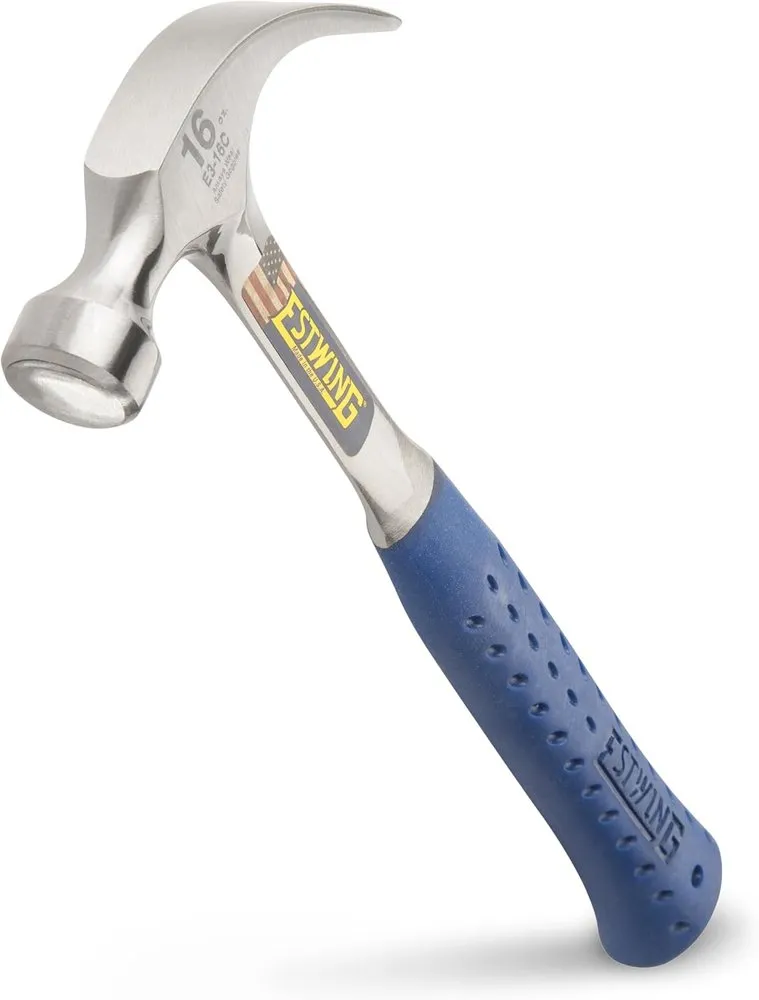
- Head and handle forged from a single piece of solid steel
- Molded Shock Reduction Grip; Estwing claims 70% less vibration
- 16 oz smooth face with a curved claw for pulling nails
Opens Amazon.com · see today's price & availability
A one-piece forged steel hammer with a smooth face, a curved claw and Estwing's blue Shock Reduction Grip. Here's who it suits, from serious DIYers to finish carpenters.
Quick verdict
The Estwing 16 oz Curved Claw Hammer is a one-piece forged steel hammer with a smooth face, a curved claw and a molded-on Shock Reduction Grip. Sixteen ounces is the all-round weight for carpentry and home projects, and one-piece construction means the head can never loosen. Framers who want a heavier, milled-face hammer should look further, but as a do-everything hammer it is hard to beat.
Pros and cons
What we like
- One-piece forged steel: no head to loosen and no handle to snap
- Shock Reduction Grip is molded on rather than glued
- Smooth face leaves a clean mark on trim and finished surfaces
- Curved claw adds leverage for pulling and prying nails
- 16 oz head is a versatile weight for most carpentry and DIY
- Made in the USA in Rockford, Illinois
What could be better
- A smooth face can glance off nail heads more than a milled face
- Lighter than the hammers many framers prefer for big nails
- A curved claw is weaker at demolition prying than a straight rip claw
Key features, explained
Forged in one piece
Estwing's approach is simple: the head and handle are forged from a single piece of solid steel, then fully polished. With no wooden or fiberglass handle, there is no joint to loosen, no wedge to fall out and no handle to snap just below the head. Estwing says the design gives the hammer exceptional balance and temper, and it calls its one-piece striking tools the most durable, longest-lasting it can make.
Shock Reduction Grip
A bare steel handle would sting, so Estwing molds its patented Shock Reduction Grip directly onto the handle rather than gluing it on. The company says the grip reduces impact vibration by 70 percent while staying slip-free and comfortable in all jobsite conditions. On this model it is the familiar blue. Over a long session of nailing, that reduction in sting is the difference between a hammer you tolerate and one you actually reach for.
Smooth face, 16 ounces
The 16-ounce head is the classic all-purpose weight. It has enough mass to sink common nails without wearing out your arm, and it stays controllable for trim, cabinetry and household repairs. The striking face is smooth rather than milled, so it won't leave a waffle pattern in wood you plan to leave on show. If you mostly drive large framing nails, a heavier hammer with a milled face will sink them in fewer blows.
Curved claw for pulling nails
The curved claw rolls against the work as you lever back, and Estwing says the shape adds torque when pulling and prying nails or boards. That rocking action makes nail pulling smoother and gives more leverage per inch of handle travel than a straight claw. A straight rip claw is the better choice for splitting apart framing or demolition work, but for removing bent nails and light prying, the curve is the more efficient shape.
Size, origin and safe use
The hammer measures about 13 inches long, 5 inches across the head and an inch thick. Estwing positions it for framers, roofers, carpenters, contractors and serious DIYers, and it has made tools in Rockford, Illinois, from American steel since 1923. Whatever the job, wear safety glasses when striking: a glancing blow can send a nail or a chip of material flying, and a polished steel face doesn't change that.
Estwing 16 oz Claw Hammer specs
| Brand | Estwing |
|---|---|
| Model | E3-16C |
| Type | Curved claw hammer |
| Head weight | 16 oz |
| Face | Smooth |
| Construction | One-piece forged steel |
| Grip | Molded Shock Reduction Grip (blue) |
| Dimensions | 13 x 5 x 1 in (L x W x thickness) |
| Made in | USA (Rockford, Illinois) |
| Prices change often. See the live price: Check Price | |
Who should buy it?
Great for
- Homeowners and DIYers who want one hammer for nearly everything
- Trim, cabinetry and finish work where a milled face would mark wood
- Anyone who has broken a wooden handle or lost a loose head
Skip it if
- You frame all day and want a heavier, milled-face hammer
- You do a lot of demolition and need a straight rip claw
- You prefer the feel of a wooden handle
Frequently asked questions
Is a 16 oz hammer heavy enough for framing?
It will drive framing nails, but it takes more blows than a heavier framing hammer. Sixteen ounces is the all-round weight for general carpentry, repairs and DIY projects.
What is the difference between a smooth face and a milled face?
A smooth face leaves a clean mark and suits trim and finished surfaces. A milled, waffled face grips nail heads better but leaves a textured mark in the wood.
What does the Estwing Shock Reduction Grip do?
It is molded onto the steel handle and, according to Estwing, reduces impact vibration by 70 percent while giving a slip-free, comfortable hold.
Why choose a curved claw over a straight claw?
A curved claw rocks against the work for smooth leverage when pulling nails. A straight rip claw is better for prying boards apart and for demolition.
Where is the Estwing E3-16C made?
In the USA. Estwing has made its tools in Rockford, Illinois, from American steel since 1923.
Final verdict
The Estwing 16 oz Curved Claw Hammer earns its reputation the straightforward way. One-piece forged steel removes the weak points of a two-part hammer, the molded Shock Reduction Grip takes the sting out of a steel handle, and the smooth face and curved claw suit the widest range of everyday carpentry. Dedicated framers may want more weight, but for nearly everyone else it is a hammer to buy once and keep.
Check PriceOpens Amazon.com · see today's price & availability
